
I'm tired of what I continuously find in social audits. Out of the five to six hundred audits I have delivered in the last four years, I would estimate that roughly 70 per cent of the sites using agency labour are doing something wrong with pay. Some are significant and some are more subtle, but it is incredibly common in the UK that workers are not receiving the wages that they are owed. When we discuss forced labour, we talk about deception and coercion of the most vulnerable. What we discuss far less is that deception, in its quieter forms, is endemic across the UK labour market. Audits rarely pick it up. Auditors are not trained for it; too many audit firms deploy overseas auditors with no grasp of the subtle domestic regulations that govern agency work; and it is always the most vulnerable in the supply chain who lose out. One recent audit stays with me on this deception.
The agency had miscalculated holiday for its entire workforce, basing every entitlement on the statutory minimum. The site paid its own people more, but none of that reached the agency workers standing beside them, creating a quiet two-tier system of discriminatory working conditions on a single shop floor. For the eighty agency workers on that site, the money owed came to around £50,000. Nothing dramatic had happened. No wages had visibly gone missing. Just a series of subtle choices, each one ensuring the agency kept the money and the workers never knew it existed. Now you might think £50,000 owed to the workers is a lot, but this is on the lower end of typical remediation amounts owed when an agency's interpretation of the legislation has been wrong for many years.
That is the thing about wage theft: nobody steals a wage all at once.
As it actually happens, it is much quieter than the phrase suggests. A percentage that never gets recalculated. A payment issued in a form that cannot be cashed. An entitlement that exists, accrues and expires without the person who earned it ever being told it was there.
I have spent twelve years auditing supply chains, more than 1,500 audits across factories, farms and mines, over 400 of them of labour providers, and if that fieldwork has taught me one thing, it is this: the theft that does the most cumulative damage is the theft designed to be boring: subtle, deniable, and defended with the claim that the legislation was simply misinterpreted.
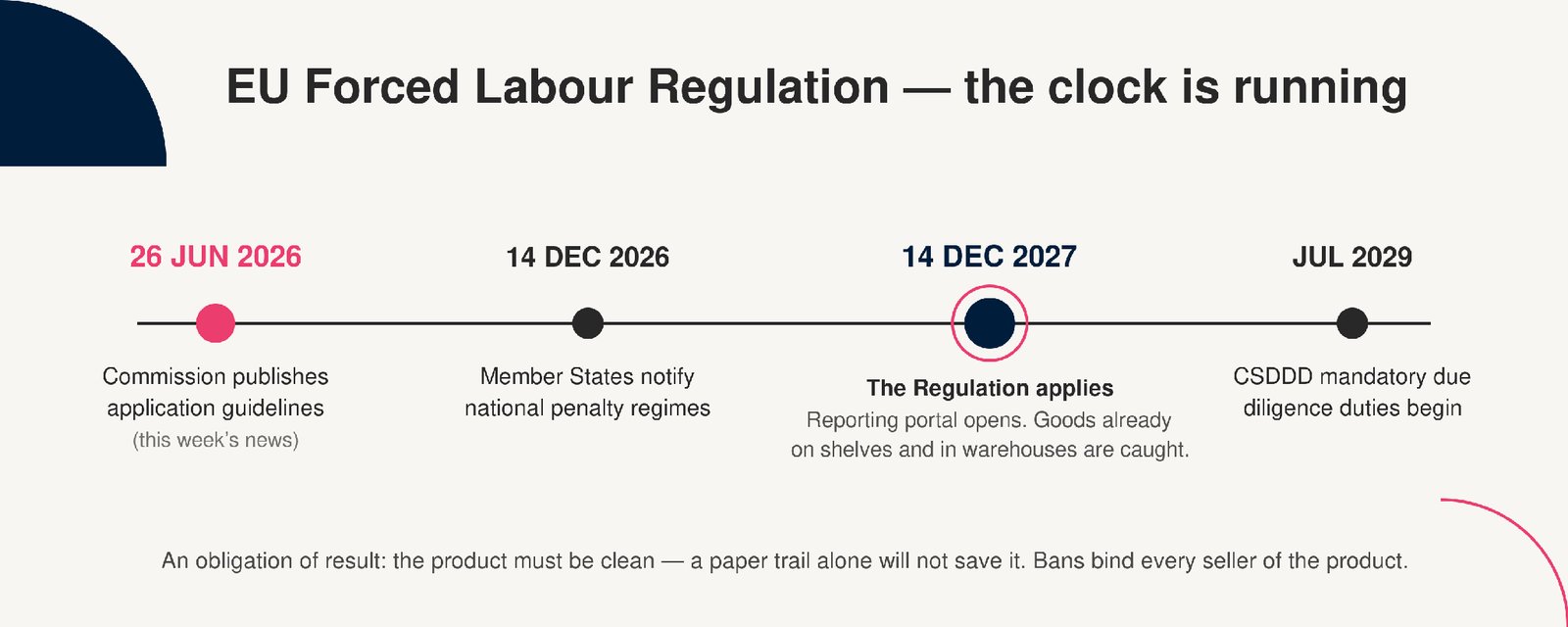
It is worth talking about now, because this week the European Commission published its guidelines on the application of the Forced Labour Regulation, Regulation (EU) 2024/3015, which from 14 December 2027 will prohibit any product made wholly or partly with forced labour from being placed on, made available on, or exported from the EU market.
These new regulations are detailed, pragmatic and, in places, quietly radical. They are also, mostly, being read as a document about distant risks: state-imposed programmes, high-risk commodities, faraway tiers.
I want to make a different argument, and it starts with vulnerability.
Forced labour does not distribute itself evenly across supply chains; it concentrates where vulnerability concentrates.
The workers at greatest risk anywhere are the ones with the least information, the least language capabilities and the fewest alternatives, and in most mature markets, that description fits one group above all: agency-supplied migrant labour within the UK labour pool.
So here is the uncomfortable arithmetic. Sixteen years after the Agency Workers Regulations (2010) came into force specifically to better protect agency workers, in somewhere between 60 and 80 per cent of sites using agency workers, those workers, the most vulnerable people on site, are being subtly exploited through the methods this piece describes. This needs to serve as a wake-up call. If one of the most heavily regulated and audited countries in the world still cannot fix identification and remediation for those most vulnerable, then applying the requirements of the EU Forced Labour Regulation will be incredibly challenging in tiers of supply chains where leverage and oversight are even lower.
Let me be precise about the claim, because precision matters in this field: I am not saying this is forced labour. I am saying that we have known exactly who the vulnerable are for sixteen years, written rules specifically for them, and are still walking past their subtle exploitation, and that the distance between what the new regulation targets and what I find on perfectly ordinary audits, in markets every risk model paints green, is much shorter than our industry likes to believe.
And the timing matters. The current landscape is marked by a combination of rising legal expectations and increasingly constrained operational margins. Labour providers continue to operate in a highly competitive market where charge rates have been under pressure for years. At the same time, many workers are facing cost-of-living challenges, while compliance and due diligence teams are managing an increasingly complex regulatory environment with finite resources.
These conditions can increase the risk of payroll errors or compliance gaps, not necessarily because businesses intend to underpay workers, but because complex payroll processes, commercial pressures, and limited oversight can allow issues to go unnoticed or remain unaddressed. It is into this environment that the new regulation is being introduced.
The Theft You Can Walk Straight Past
Let me describe what wage theft looks like when I actually find it. None of this is hypothetical, and none of it is rare. I do most of my fieldwork in one of the most heavily regulated labour markets in the world, but nothing that follows is unique to it.
Start with holiday pay, as an example. Temporary workers are routinely paid holiday at a flat, statutory-minimum percentage which equates in the UK to 12.07% of all work conducted. Where entitlement should match that of an equivalent worker, the percentage is simply never recalculated after 12 weeks, even though the Agency Workers Regulations 2010 say it must. I find workers one, two, three years into the same job whose holiday accrual has never once been reviewed and is in direct violation of the AWR.
In one recent case an entire agency workforce had been underpaid holiday, around five days per worker, over a significant period. The calculation was corrected the moment the finding was raised. The back-payment, at the time of writing, still has not been made, over a year and a half later, and probably never will.
Then there is the other side of this: holiday accrual nobody mentions, that workers don't understand, and that will never be taken or paid out even on ceasing to work for the labour provider.
The most consistent finding of my career is holiday that is never taken and never paid out, because the worker does not know it exists.
I have sat across the table from workers owed thousands who had no idea anything had accumulated. The key information documents are deliberately vague, the assignment details don't mention it, and so the documents that were supposed to tell workers their entitlement are deliberately deceptive and inaccurate. I have seen sites where leave was blocked during the busiest months of the year, softened with a promise that it would all be settled in a year-end lump sum, only for the labour provider to turn around and say this cannot be paid in a lump sum. This was during an audit two months ago, not in the distant past. Many of these workers are temporary, seasonal or short-term. The agricultural workforce is full of them. They never need holiday during that short window, and never know to ask for it when they leave the labour provider.
Leaving is where it gets creative. Some providers will not release final paperwork or outstanding pay until the worker formally "signs out" through an online portal, at which point the P45 is issued and all entitlements should be paid. Even workers who tell the labour provider they are leaving, in person, make no difference: no click, no payout, sometimes for the better part of a year, by which point the worker has left the country and closed their bank account.
Understand who this barrier is built for. Many of these workers cannot confidently use a computer at all; some have never needed to. And lest that sound like an excuse, on a recent audit I sat down and attempted the leaver process myself, following it exactly as a worker would. It was multi-step, counterintuitive, and presented in a language the workforce did not speak.
If a trained auditor must concentrate to complete it, a seasonal worker with no laptop and a second language has no realistic chance, which is, I have come to conclude, the point. This is not a badly designed system; it is a well-designed one. Others skip the portal and simply issue final entitlements by cheque, at the end of the season, to workers everyone involved knows have already flown home and cannot cash it.
And then the small print. Mandatory induction training, typically four hours, unpaid, because it has been reclassified as a "pre-employment" condition; I have raised that finding three times in the last two months alone. Personal protective equipment workers are left to buy for themselves. Piece rates propped up to the legal minimum with "attendance allowances" that are linked to no productivity requirement and do not comply with minimum wage rules. Pension costs charged to the client from a worker's first day, while the worker is told they must wait months before they can join. Self-employment contracts issued to people who are, in every observable respect, directed like employees, a classification that conveniently removes payroll taxes from the equation. Workers who have never been told how to raise a grievance, and in some cases have been told, flatly, that the union at their site is not for them. Workers told they cannot take bank holidays off despite the sites they work at being shut, which ensures the holiday owed to them isn't paid to them.
Some sites also resort to deliberately deceptive practices. During a recent factory audit, I uncovered a case where the operations manager had, over several months, systematically changed employees' job titles and subtly altered their job descriptions. The apparent goal was to avoid paying agency workers the legally required parity pay by creating the illusion that they were not performing "like-for-like" work.
By reviewing training records and gathering testimony from employee interviews, I was able to demonstrate that the work being carried out was, in reality, substantially the same. The evidence was strong enough to justify raising major audit findings. Most remarkably, the manager openly admitted that the changes had been a deliberate strategy to reduce the site's wage bill.
This case illustrates one of the fundamental principles underpinning forced labour: deception. Alongside coercion, deception is one of the hardest indicators to identify because it is often designed to appear entirely legitimate.
Some readers may imagine that forced labour always presents itself in obvious ways. Occasionally it does, for example, where there are clear links to Xinjiang, threats of violence against workers who speak out, or prolonged withholding of wages. However, these are often the exception rather than the rule.
The vast majority of forced labour indicators are far more subtle. They require an investigator with the knowledge and experience to recognise inconsistencies, ask the right questions, and follow seemingly minor anomalies wherever they lead. In the example above, a discrepancy over job titles was not simply an employment issue, it was evidence of deliberate deception.
I've uncovered forced labour in UK agricultural fields, and time and again it has been these subtle indicators that have provided the first clues. Careful questioning, conducted in the right way, gradually uncovers further evidence until it becomes clear that workers are being seriously exploited.
For every significant case that is successfully identified, I suspect there are dozens more that remain hidden, not because the indicators aren't there, but because the wrong people are looking at the wrong things, or don't know which questions to ask.
Across the labour providers I audit, I would estimate that in roughly seven out of ten sites using agency labour, the equal-treatment entitlements that exist on paper are not fully happening in practice. Moreover, they are often not even tracked for the 12-week AWR threshold, and haven't been tracked for years. For some of these agencies, we are talking hundreds of thousands of pounds owed to workers.
Individually, each of these gets written up as a non-conformance. Administrative. Low severity, an oversight from the labour provider.
The Structure Is Doing Exactly What It Was Built to Do
To understand why this is so persistent, look at the structure. Agency labour is a triangle.
The labour user (the farm, factory or warehouse) directs the work, day to day. The labour provider (the agency) "employs" (loosely speaking, on a contract for services) and pays the worker. The worker stands at the third corner, doing the job at one company while being paid by another.
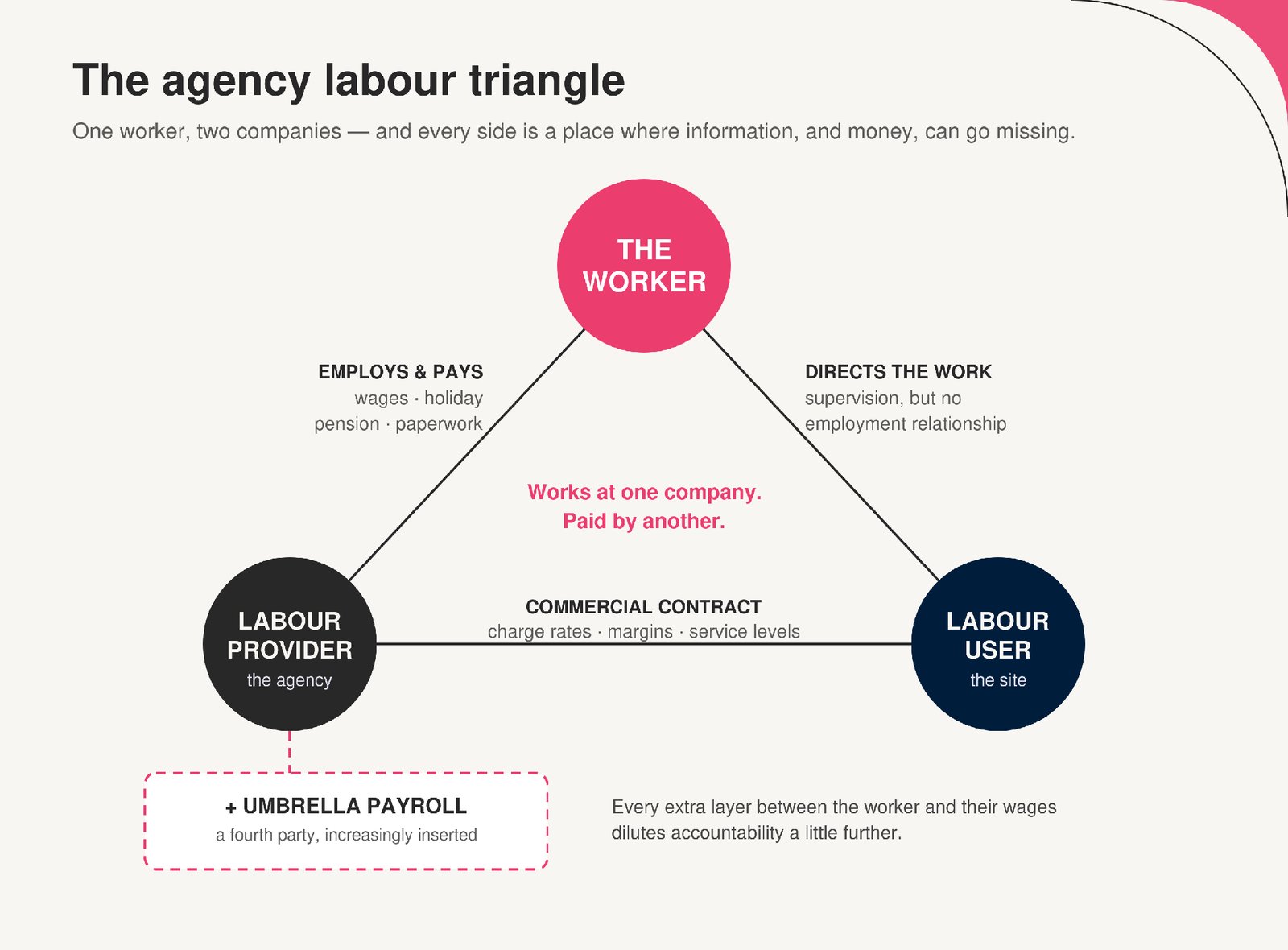
On every side of that triangle there is an information gap. The site assumes the agency is handling pay correctly. The agency points to the site's instructions. The worker often does not know which entity employs them, and increasingly, a fourth party is inserted beneath the agency: an umbrella payroll company.
On a recent audit I found workers who had been moved onto an umbrella arrangement after roughly three years of continuous full-time work on the same site, without being told their previous employment had ended, on contracts that did not explain who employed whom or what had happened to their accrued rights.
I am not against the triangle. Flexible workforces need intermediaries, and the good labour providers I audit (they exist, and they deserve more credit than they get) add real value at every corner of it.
The problem is not the structure. The problem is that every additional layer dilutes accountability, and most oversight was never designed to follow the money through the layers.
A site audit that treats the labour provider as a supporting document rather than a subject is an audit of the place where the work happens, not of the arrangement the worker is employed under.
From Minor NC to Forced Labour Indicator
Here is where this week's guidelines become uncomfortable reading, in the best sense. The Forced Labour Regulation takes its definition directly from ILO Convention No 29: work exacted under coercion, for which the person has not offered themselves voluntarily. Two elements, involuntariness and coercion, assessed together. The Commission is explicit that coercion can be indirect and subtle.
Among the ILO indicators authorities are told to look for, alongside violence and document retention, sit two quieter entries: deception and withholding of wages.
Now re-read my findings through that lens.
An entitlement that depends entirely on the worker asking, where the worker has been kept from knowing there is anything to ask for, is not a payroll error. It is deception, functioning as designed. A leaver process engineered so that the money is technically owed but practically unreachable is withholding of wages with extra steps. And the reason these techniques work at all (limited language, unfamiliar rules, seasonal contracts, no or incorrect information provided) is what the ILO calls "abuse of vulnerability".
I want to be careful here, because precision matters in this industry. None of the findings I have described amounts, on its own, to forced labour, and I am not claiming otherwise.
But the difference between "subtle wage theft" and "forced labour indicator" is one of degree, not of kind.
These are the same behaviours that the EU has just built an entire enforcement regime to eradicate. An industry that files them under administrative non-conformance is an industry measuring the wrong end of the continuum.
Due Diligence Is Being Asked a Better Question
The UN Guiding Principles on Business and Human Rights describe human rights due diligence as a continuous cycle: identify and assess actual and potential adverse impacts, integrate and act on the findings, track responses, and communicate. Know and show.
The Corporate Sustainability Due Diligence Directive is giving this a legal requirement for large companies.
And the Forced Labour Regulation adds something neither of them has: an obligation of result. A company cannot litigate its way out with a paper trail. The product must genuinely be clean, and due diligence is described throughout the guidelines as the best defence, not a shield by itself.
The guidelines carry three details that anyone running an HRDD programme should sit with. Bans are product-wide, binding anyone who sells the product, not just the operator investigated. Non-cooperation with an investigation is itself treated, in principle, as evidence. And social audits count as credible evidence only where they are conducted without restricted access and workers are genuinely free to speak, a standard that is both a challenge to my profession and an overdue compliment to the audits done properly.
It is worth being precise about where the audit sits in all of this, because the point is so often missed.
Under the UNGP architecture, the audit is an evidence-gathering tool within the due diligence cycle, a powerful one, but it is not the cycle itself. An audit deployed without prior risk identification is an audit likely to be looking in the wrong place; a finding that never feeds a corrective action plan, and a corrective action plan that never gets verified, are due diligence in form only. The new regulation sharpens that logic to a point.
When the question changes from "did you audit?" to "can you demonstrate the product is clean, and that what you found was actually fixed?", an audit programme disconnected from risk prioritisation and remediation tracking stops being merely inefficient. It becomes a liability with a letterhead.
Temporary labour supply is a blind spot in most HRDD programmes.
Risk assessments are calibrated to commodities and geographies: the minerals, the distant tiers, the conflict-affected regions. The intermediated workforce inside first-tier suppliers, in markets everyone has classified as low-risk, rarely makes the heat map. Yet judged by the UNGPs' own severity test (scale, scope, irremediability), the systematic underpayment of the most vulnerable workers in the chain belongs on it. Prioritisation is supposed to follow severity, not distance.
And when audits do look, they are often not equipped for what they find. These techniques live in payroll arithmetic: in the gap between a flat accrual percentage and what length of service requires; in what the worker was told on day one versus what the payslip says; in whether a deduction charged to the client ever becomes a benefit the worker was allowed to access.
Detecting them takes time with payroll data, fluency in employment mechanics, and worker interviews conducted with enough trust and language support that a seasonal picker will tell you what they were promised.
The Money Never Comes Back
There is one more gap, and it is the one that frustrates me most, because it is where good intentions go to die: remediation.
Recruitment fees are the clearest case. The costs of finding, documenting and placing a worker get passed down the chain (through agents, brokers and middlemen, through "optional" services that are nothing of the sort, through deposits that function as runaway insurance) until they land on the person least able to bear them. A jobseeker who borrows to pay them starts the job already in debt, and a worker in recruitment debt is a worker who cannot afford to complain, cannot afford to leave, and will absorb every one of the payroll techniques described above without a word.
Fee-charging and subtle wage theft are not separate problems; one manufactures the vulnerability the other exploits.
The standards here are settled. The Employer Pays Principle, no worker should pay for a job, is embedded across international guidance, and detailed frameworks now exist for what should happen when worker-paid fees or unpaid entitlements are found: commit, assess, act, remedy, monitor, communicate.
The Commission's guidelines take the same line, defining remediation as restoring workers, as closely as possible, to the position they would have been in, explicitly including repaying recruitment fees, paying withheld wages and returning documents.
Now the field reality. Findings get raised. Investigations happen. Corrective action plans are agreed and calculations are done, sometimes to the penny.
And then, somewhere between the finding and the worker's bank account, the money evaporates.
The workforce is seasonal and has dispersed. The records are incomplete. The repayment is issued in a form the worker cannot access. The process is corrected prospectively, and the historical liability is quietly parked.
On recent audits this has been the single most consistent failure I have seen. As someone who specialises in this area, I have become reasonably good at finding worker-paid fees and unpaid entitlements, and have done for the last ten years. But the system remains remarkably bad at putting money back into workers' hands, because the audit was done towards the end of the season, or because there was no liability written into the contracts so no one takes the blame, or because it is not enforced by the customers asking for the audits, or because the GLAA concludes fraud took place in Nepal with an intermediary who has since fled, and the money has disappeared with them. That last one happened on an audit twelve months ago.
The European Commission Forced Labour Regulation changes the economics of that failure. An operator seeking to have a ban lifted must evidence not only that the abuse has ended but that remediation has actually occurred.
"We fixed it going forward" — the reflex answer of the temporary labour market for as long as I have been auditing it — will not lift a ban.
Again, I am not saying any of what I have described is forced labour. But for the last sixteen years the industry has had the opportunity for effective remediation for vulnerable workers, and for sixteen years it has not happened even when detected. We as an industry need to significantly improve this aspect of the UNGPs. For the first time, the gap between the finding and the remedy has a price attached.
Showing Up with Better Questions
I think this regulation is good. The incentive structure points the right way: towards knowing your labour supply chain deeply, fixing what you find, and paying back what is owed. In practice that means mapping the workforce, not just the commodity (every agency, every umbrella, every second-tier sourcing arrangement), because opacity is now a liability.
It means directing audit resource by honest risk intelligence rather than spraying it defensively across a supplier base.
It means auditing labour providers as subjects (payroll-deep, interview-rich, with interpreters) rather than as footnotes to a site visit. And audits conducted by experts, not by the internal HR teams on whom the burden currently falls.
And it means remediation designed to be evidenced: if a competent authority asked you tomorrow to prove the money landed, could you?
Most of all, it means retiring a bad industry habit. The EU has just told us, in the clearest legal language available, that deception and withheld wages sit on a continuum whose far end is forced labour. We should audit, remediate and manage the near end of that continuum with the seriousness the far end demands.
The workers at the end of all this (the people picking, packing and processing through the night) do not need a perfect system. They need someone to show up in the right place, read the payslip properly, ask the quiet question twice, and follow the money until it reaches the person it belongs to.
That is the job. It has always been the job. It has just, for the vast majority even within the industry, been overlooked.